Today’s sales ecosystem demands a rethinking of how we understand not just our product, but the competitive context surrounding it.
According to Crayon’s 2025 State of Competitive Intelligence report, 68% of deals now involve at least one direct competitor. But despite that pressure, 44% of sales teams still lack visibility into which competitors are active in their deals.
That visibility gap leads to blind spots (and missed opportunities). The intel exists. But it’s not driving decisions. In a market where even a small edge can completely change the outcome of a sale, knowing your opponent is often the most overlooked factor.
That’s what competitive intelligence is all about: the continuous process of gathering, analyzing, and activating insights about your competitors so sales teams can respond faster.
In practice, this means turning scattered signals (e.g., pricing update, new feature) into clear, usable assets like battlecards or objection handling scripts. These should not be static. The best CI pipelines act as a co-pilot, surfacing insights so that you (the pilot) can approve them.

In short: competitive intelligence is not a passive activity. It’s a real-time operating system for sales teams. The difference between winning and losing often comes down to who knows more, faster. And competitive intelligence helps reps learn about competitor moves before their prospects do.
That’s what this piece is about. We’ll break down the two core collection methods (passive vs. active), show how to turn signals into assets, and walk through a repeatable workflow that directly embeds CI into your sales process.
Let’s get started.
Passive CI taps into what’s already happening, but is often overlooked. In 2024, the global conversational AI market was valued at $12 billion, and is now projected to reach around $62 billion by the end of 2025 driven by tools like Gong and Chorus that record customer calls in real time.
Why? Because almost all customer interaction data disappears the moment a call ends. Sales teams are recognizing the value in analyzing these meetings and are using these tools to catch what prospects are saying about competitors during these calls.
And these tools flag not only who was mentioned, but how, picking up sentiment based on precise language and emotional tone.
But it is not enough to just fully rely on these tools. Passive CI becomes truly effective when it’s woven into frontline behavior. The power lies in reps actively tagging competitor mentions and full-funnel feedback being shared immediately.
So yes, passive CI is about listening. But more importantly, it’s about recognizing what needs to be heard. It’s about turning every call, chat, and deal update into a potential source of intelligence.
Active CI is fully intentional. It’s about monitoring multiple channels so the sales team can see competitor moves before they’re customer facing. Here’s what it looks like in the field.
When you combine all three, you give your sales team enough time to prep right. That early visibility lets you refine battlecards, reposition product demos, and update messaging to avoid being blindsided.
This shifts sales from reactive to proactive. And to be effective, you need both passive and active CI.

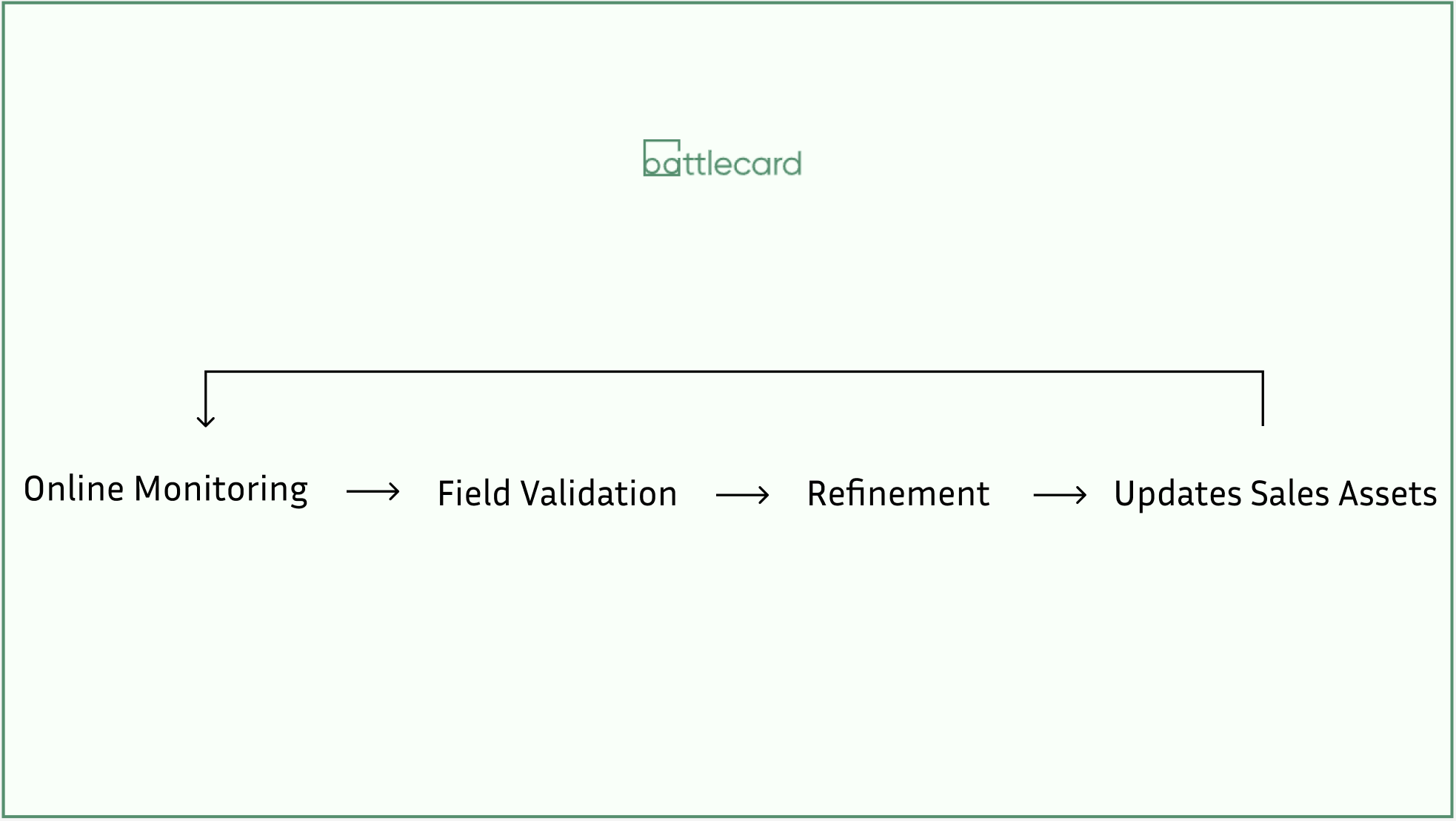
Passive and active CI work together. Proactive monitoring helps you spot competitor shifts before they hit your pipeline. But reps in the field validate what really matters. A competitor might roll out a new feature, but if it doesn’t show up in talk tracks, it may not be worth responding to.
Conversely, reps often surface new intel that hasn’t yet made it into public forums. That feedback should be reported back into your monitoring systems so you know what to track more closely.
Best practice is to treat this as a loop. Field insights tighten assumptions. Monitoring fills gaps. Then the next version of your battlecard, objection handling script, or demo narrative gets sharper.
But gathering intel is only part of the equation. How do you transform those insights into assets that actually help your reps win?
You don’t need a dedicated CI team to build a high impact intelligence system. What you need is a simple, repeatable workflow that captures insights and stores them in one place. This works best when embedded into existing systems that reps already use. Here’s what that can look like.
Start with a #CI Slack channel. Anytime a competitor is mentioned on a call, in an email thread, or during a deal review, reps should drop it in. This becomes your front line intelligence log. Reps can also tag competitors directly in Gong call summaries using smart trackers.
Post-deal, use a lightweight Google Form or a Slack workflow to collect win/loss insights. Remember, its important to push a proactive mindset onto reps where they actively listen for relevant details. It doesn’t have to take long. It can be three quick questions.
On the automation side, layer in active monitoring. Tools like Crayon, Kompyte, or Klue can track 300+ digital sources across competitor websites, help docs, blogs, and pricing pages. Add public sources too. Reddit threads and communities give an environment for users to discuss solutions in a candid manner.
After capturing intel from the field (Slack, Gong, etc.) and public sources (competitor sites, reddit, etc.), the next step is to centralize it. Not in a dusty, forgotten folder, but in a shared, searchable source of truth that reps can actually use to add value.
[H4] What does “centralized” actually mean?
Whether you’re using Notion, Google Docs, or dedicated CI platforms like Crayon or Klue, the bar is the same.
Capturing intel is step one. Centralizing is step two. But the biggest lift in win rates? Ensuring intel reaches reps without them ever having to search for it. The activation layer is where competitive intelligence becomes operationalized.
Instead of static docs, use smart triggers and integrations to put things in motion.
The bottom line is that you want to think like an engineer. With automation, intel moves itself. The shift goes from manually updating every piece of information to focusing on optimizing the workflow.
It is important to note, however, that human oversight should always be required to keep information trusted. Use automation as a means to get intel, but not as the end-all-be-all.
The review loop is where the team can validate. It is where strategy can be refined and intel can be vetted. Run a quick weekly CI stand-up to:
The more stand-ups that happen, the more momentum is built. Reps are more likely to trust and engage with the system. It uses reflection to see what’s landing, what’s outdated, and what needs refining.
When you combine all four layers together, you build a living system where both passive and active intel is being iterated upon. Signals are sensed at the edges (field reps, market monitoring), processed centrally, and then sent to the right assets.
If there’s one takeaway from this paper, it is this. The best CI programs don’t compete on access to data. They compete on speed to action. Most sales teams already have access to the same intel, but the differentiator is how quickly you can detect a meaningful shift, decide if it matters, and then feed it to reps.
That’s why it is so important to treat CI as an operational discipline. It’s less about “keeping tabs” and more about building a workflow that helps the entire GTM team anticipate the next move. When automation is woven into that workflow, you collapse the gap between discovery and deployment. And in 2025, that is the baseline for staying competitive.
What’s the biggest mistake sales teams make with competitive intelligence?
Treating CI as a static document rather than a living process. Many teams create battlecards once and never update them, which means reps are working off stale or irrelevant intel.
Do I need a dedicated CI team to run this workflow?
Not necessarily. Smaller teams can automate the capture, aggregation, and activation process. What’s more important is having clear ownership and regular review.
How do I convince reps to actually share competitive intel?
Make it easy and valuable. Use a simple capture channel (like #CI in Slack) and recognize reps who contribute. Show them how their intel directly improves win rates to reinforce the habit.
What’s the ideal balance between passive and active CI?
Use passive CI to uncover what’s already happening in the field (customer calls, deal reviews) and active CI to spot competitor shifts before they appear in conversations. Both are essential. One without the other creates blind spots.
How often should CI assets like battlecards be updated?
As often as your market moves. In fast-changing industries, review and update them weekly or bi-weekly. For slower-moving markets, monthly or quarterly may be enough. But don’t wait for major losses to trigger an update.
Can automation replace manual CI work?
Automation accelerates capture and distribution, but it can’t replace human judgment. You still need a person to interpret signals, decide if they’re relevant, and shape them into actionable guidance for reps.
How do I measure if my CI program is working?
Track metrics like battlecard usage, win rates in competitive deals, speed from intel capture to activation, and rep-reported confidence when facing competitors.